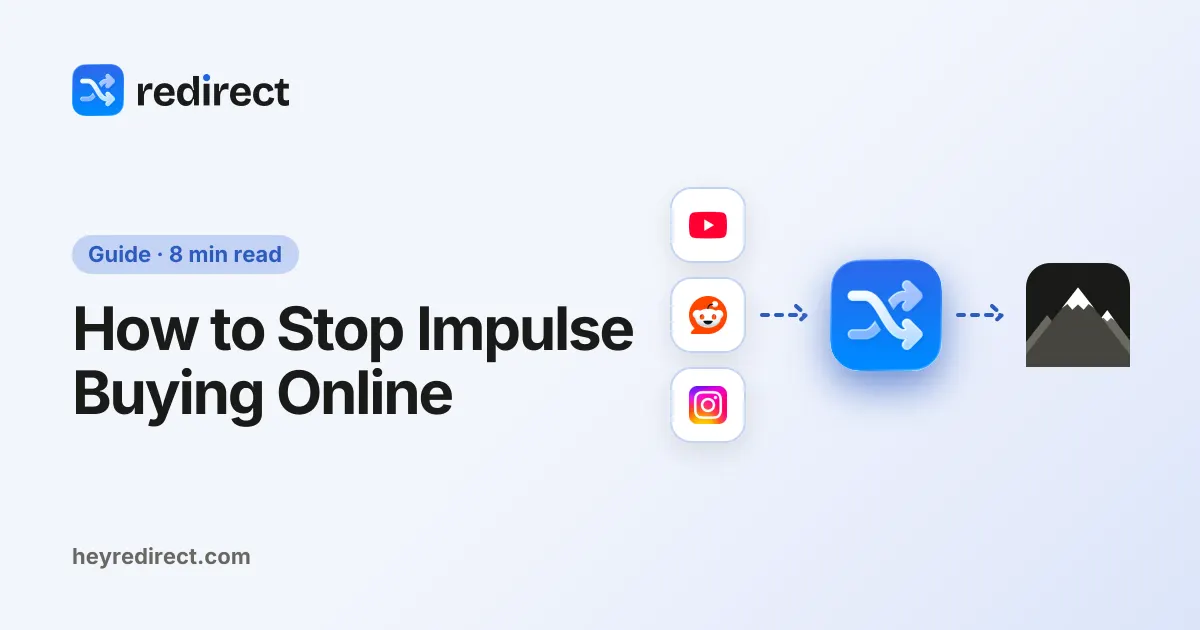
To stop impulse buying online, add distance between the urge and the checkout: keep a 48 hour wait list, remove saved cards, unsubscribe from sale emails, and make opening a store cost a small, deliberate step. In Chrome, Redirect, the Chrome extension, can send amazon.com and other stores to your goals and ask for a written reason before each visit; it works in Chrome and Chromium browsers only, keeps data local, and is free for one site.
On this page
You open Amazon to check the price of one thing. Twenty minutes later there are three things in the cart, a "deal ends in 2:14:07" timer is counting down, and the one thing you came for is not one of them.
That is an impulse buy, and it is not a character flaw. In his classic paper The Buying Impulse, consumer researcher Dennis Rook described it as a sudden, often powerful and persistent urge to buy something right away. Online stores are very good at triggering that urge and very good at removing every step between it and the checkout.
The fix is the same idea in a few forms: put a little distance back between wanting and buying.
Why is impulse buying online so easy?#
Three things make the browser the easiest place to buy on impulse.
The store is always one tab away. A shop on your street closes at night. A shopping site opens in the same reflex as checking email, at 11pm, when you are tired and least likely to say no.
The page is built to hurry you. Researchers at Princeton and the University of Chicago crawled about 53,000 product pages on around 11,000 shopping sites and, in Dark Patterns at Scale, found 1,818 dark pattern instances across 15 types. They include countdown timers, "only 2 left" messages and notices that someone else just bought the item. Each one says the same thing: decide now, do not think.
Paying takes no effort. Saved cards, one-click checkout and "pay in 4" buttons remove the moment where you would normally feel the cost. The US Consumer Financial Protection Bureau found that five buy now, pay later lenders originated 180 million loans worth over $24 billion in 2021, nearly ten times their 2019 volume, and warned that the product is engineered to encourage people to buy more.
None of this needs willpower to beat. It needs friction in the right places.
Ways to stop impulse buying, compared#
| Tactic | What it stops | Effort to set up |
|---|---|---|
| A 48 hour wait list | Buying in the heat of the moment | None |
| Removing saved cards | One-click checkout | 5 minutes |
| Unsubscribing from sale emails | The trigger that starts the browsing | 10 minutes |
| An if-then plan | Opening a store on autopilot | 2 minutes |
| A pause before the store opens | The reflex visit itself | 5 minutes in Chrome |
| Skipping buy now, pay later | Spending money you do not have yet | None |
You do not need all of them. Pick the two or three that match how your impulse buys usually start.
How to stop impulse buying: 7 steps#
1. Keep a wait list instead of a cart
When you want something you did not plan to buy, write it on a list with the date, and wait 48 hours before you decide. Use a notes app, not the store's cart or wish list, because the store will email you about anything you leave there.
Most items on the list will look less exciting two days later. The ones that still make sense after the wait are probably real needs, and you can buy them without guilt.
2. Remove saved cards and one-click checkout
Delete the cards saved in the stores you overspend in, and turn off card autofill in Chrome (Settings, then Autofill and passwords, then Payment methods). Having to find your wallet and type 16 digits is a small task, and small tasks are exactly where an impulse tends to fade.
3. Cut the triggers
Unsubscribe from sale and "back in stock" emails, switch off shopping app notifications, and unfollow the influencers whose posts send you to a store. Every one of these is an invitation to browse with no plan.
4. Write an if-then plan
Decide in advance what you will do at the moment the urge hits, in one sentence: "If I open a store without a list, then I close the tab and add the item to my wait list." Plans in this if-then form, called implementation intentions, had a medium to large effect on reaching goals across 94 tests in a meta-analysis by Gollwitzer and Sheeran. The point is that you are not deciding in the moment. You already decided.
5. Block the stores you browse, not the ones you need
Most impulse buys happen on a handful of stores. Find yours: check your browser history or your last three months of orders. Then put a pause in front of those stores in your browser, and leave the stores you buy planned things from alone.
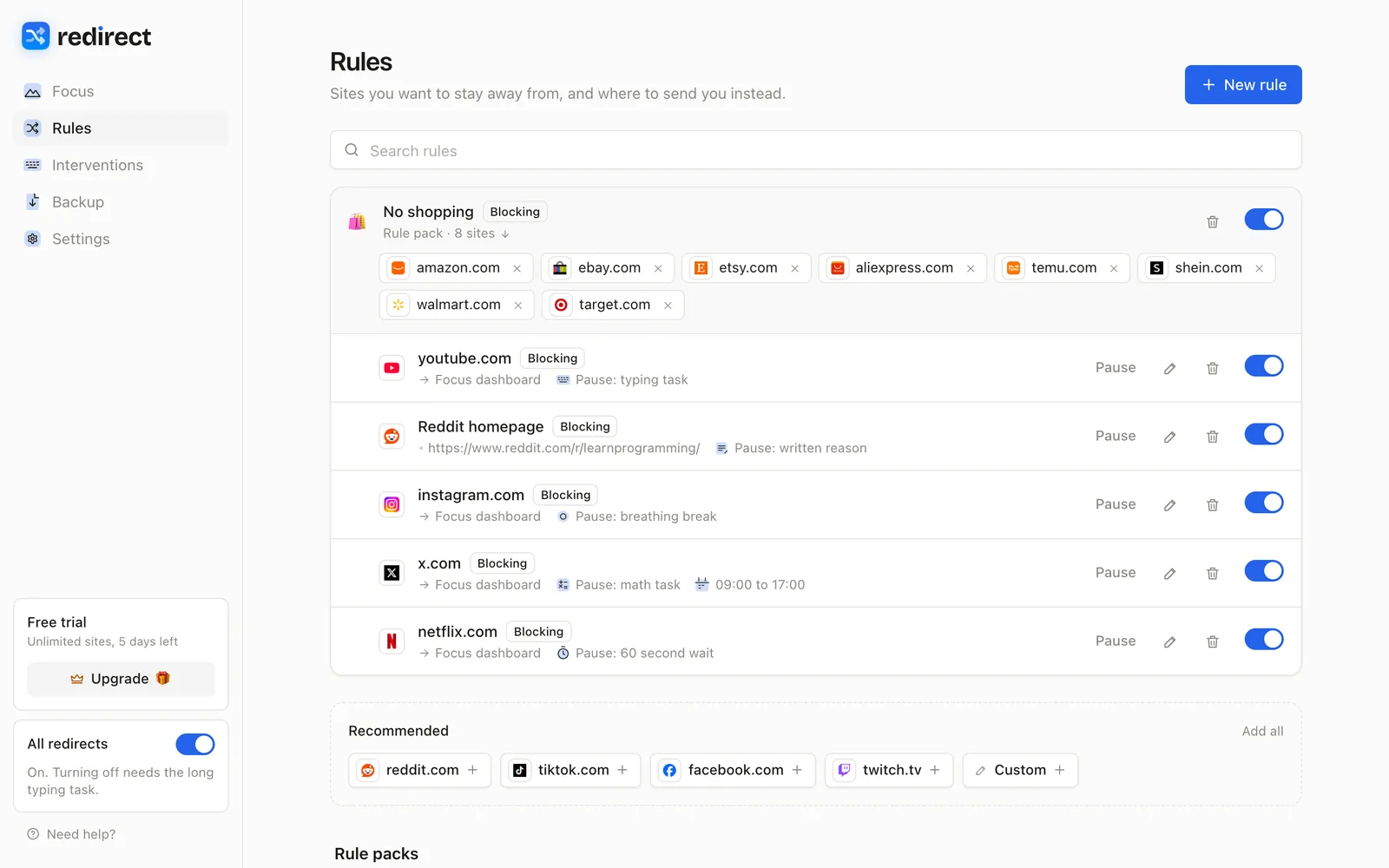
The steps for doing this in Chrome are below.
6. Send the urge to your goals
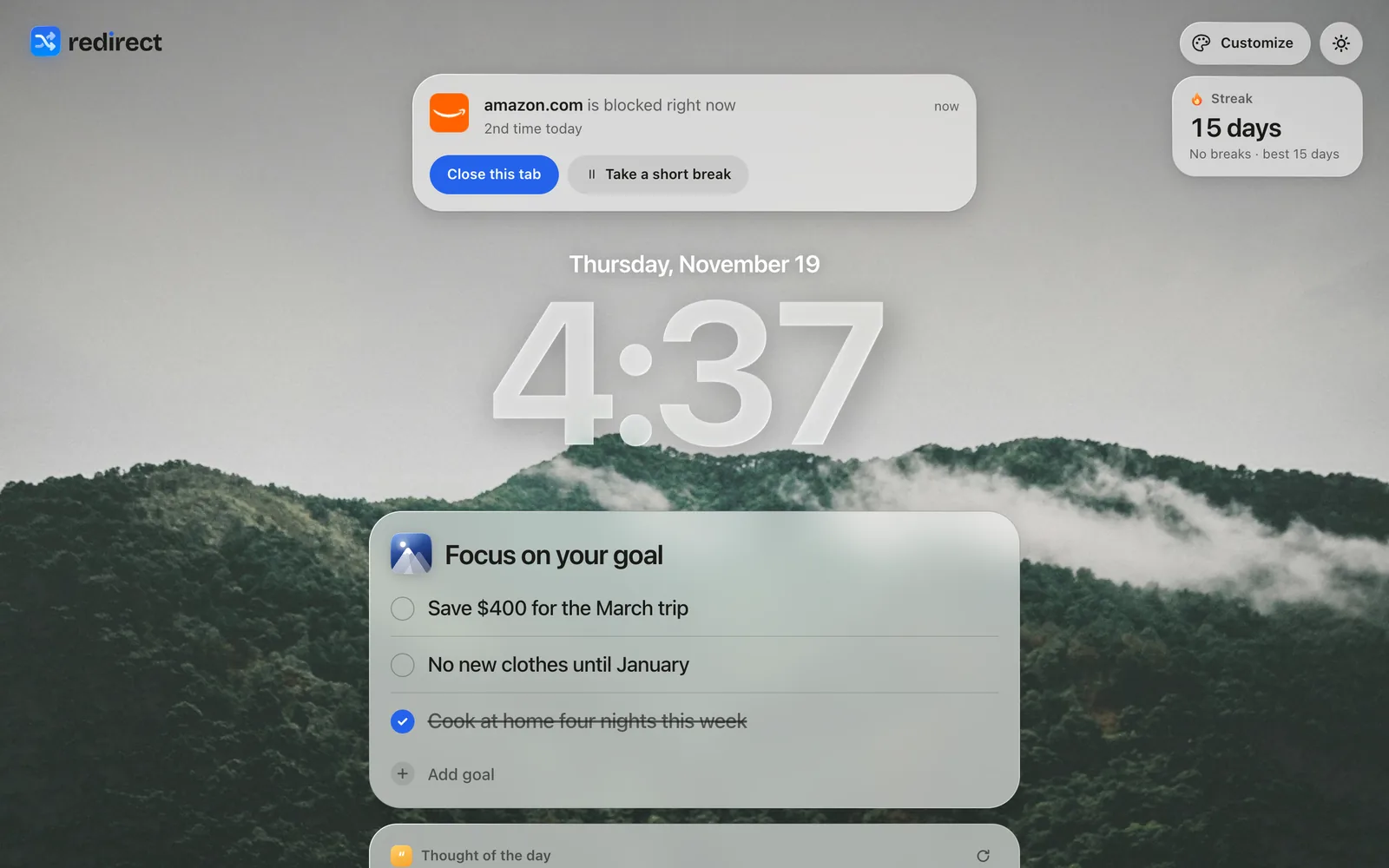
A blank "this site is blocked" page gives you nothing to do instead, so the urge looks for another store. Sending yourself to the goal the money is for works better: the trip you are saving for, the debt you are paying off, the "no new clothes until January" rule you set yourself.
7. Skip buy now, pay later for anything you did not plan
Splitting a payment into four makes a price feel smaller without making it smaller. If you would not buy it for the full price today, a payment plan is a sign to put it on the wait list instead.
How to block shopping sites in Chrome with Redirect#
Redirect is a Chrome extension that sends sites you choose to your goals instead of a block page. When you want in anyway, you can, after a small task. For shopping, that task is the moment of distance the steps above are about.
1. Install the extension
Add Redirect from the Chrome Web Store. It also works in Edge, Brave, Arc, Opera and Vivaldi.
2. Add a rule for the store you use most
Open the dashboard, add a rule and type the store, for example amazon.com. A whole-site rule covers the store's subdomains too. If you shop from a country store such as amazon.co.uk, add it as its own rule. The free plan covers one site, so start with the store that costs you the most.
3. Write your goals on the Focus page
Blocked stores send you to your Focus page, which shows the goals you write yourself. Make them about the money: what you are saving for, and by when.
4. Make every visit start with a reason
Set the rule's pause task to the reason prompt. Before Redirect lets you into the store, you write down why you need it right now (80 characters by default), and the reasons you gave last time are shown back to you. Reading "saw a lightning deal, already have two pairs" is a strong check on the next lightning deal.
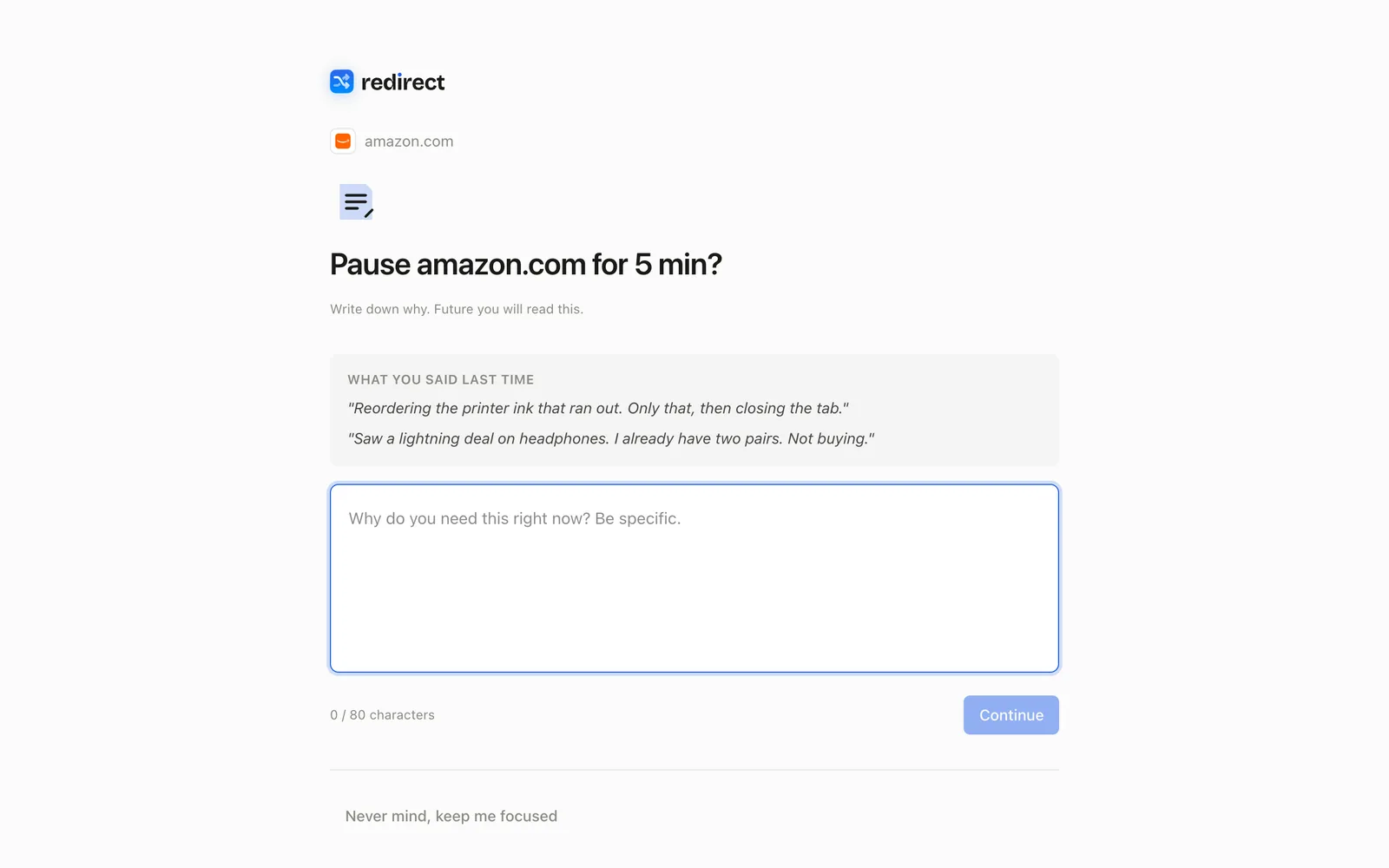
Keep pauses short, 5 or 10 minutes, so a planned purchase still fits, and set a daily pause limit so "just one more look" has a ceiling.
5. Add a schedule for your weak hours
If your impulse buys happen late at night, give the rule a schedule, for example every day from 20:00 to 07:00. Overnight windows work. The store stays open during the day, when you are more likely to shop with a list.
6. Turn on the No shopping pack for the rest
To cover more stores at once, the No shopping rule pack adds amazon.com, ebay.com, etsy.com, aliexpress.com, temu.com, shein.com, walmart.com and target.com with one switch. Pack sites use the typing challenge before a pause. A store you already have your own rule for stays yours, so you can keep the reason prompt on Amazon and let the pack cover the others. Rule packs are part of Redirect Pro and Redirect Lifetime, and they run during the 7 day free trial; see pricing.
A few honest limits: Redirect works in Chrome and Chromium browsers only, not in shopping apps on your phone. Like any extension, it only runs in Incognito if you turn on "Allow in Incognito" in chrome://extensions. And it cannot stop you from opening another browser. It adds friction, not a lock.
A plan for Black Friday and other sale weekends#
Big sale weekends stack every trigger at once: countdowns, "lowest price of the year" banners and a flood of emails. A plan made a week before works better than willpower on the day.
- Write your list now. The things you actually need, with a price you are happy to pay for each.
- Set a total budget for the weekend, and write it on your Focus page as a goal.
- Unsubscribe or filter sale emails into a folder you check once, with your list next to you.
- Buy only from the list. Anything else that catches your eye goes on the wait list, and the wait outlasts the sale. If it is still a good idea next week, buy it then, on purpose.
- Keep your store rules on during the sale. A short pause for a planned purchase is a small price; a 2am browse with no pause is where the budget goes.
The bottom line#
Impulse buying online is a design problem more than a willpower problem: the store removes every step between wanting and paying. Put a few steps back. Wait 48 hours, delete the saved card, cut the sale emails, and make opening your most expensive store start with a reason and a look at your goals. Most impulses fade before the task is done. The ones that do not were probably worth buying.
For Amazon specifically, see how to block Amazon on Chrome. If scrolling feeds is the bigger drain, read how to stop doomscrolling.
Sources
- Rook (1987), The Buying Impulse, Journal of Consumer Research (checked November 2026)
- Mathur et al., Dark Patterns at Scale, Proceedings of the ACM on Human-Computer Interaction (2019) (checked November 2026)
- Consumer Financial Protection Bureau (2022), CFPB Study Details the Rapid Growth of Buy Now, Pay Later Lending (checked November 2026)
- Gollwitzer and Sheeran (2006), Implementation Intentions and Goal Achievement: A Meta-analysis, Advances in Experimental Social Psychology (checked November 2026)

Close the tab. Open your goals.
Redirect sends distracting sites to the goals you wrote down, and makes every pause a choice.
Questions, answered
Why do I impulse buy online so much?
Online stores are always one tab away, they use urgency cues like countdown timers and low-stock messages, and saved cards remove the moment where you feel the cost. A study of about 11,000 shopping sites found 1,818 such dark patterns. Adding friction back, like a wait list or a pause before the store opens, works against all three.
Does the 48 hour rule actually work?
It works for the same reason any pause does: an impulse is strong but short, and waiting gives it time to fade. There is no single study of the 48 hour rule itself, so treat the exact number as a starting point. Some people use 24 hours for small items and 30 days for big ones.
Can I block shopping sites in Chrome for free?
Yes. Redirect is free for one site, so you can add a rule for the store you overspend on most, with a written reason before each visit. The No shopping rule pack, which covers eight major stores at once, is part of Redirect Pro and Redirect Lifetime and runs during the 7 day free trial.
Does Redirect block shopping apps on my phone?
No. Redirect is a browser extension for Chrome and Chromium browsers on desktop and laptop. It has no effect on the Amazon, Temu or Shein apps on your phone, so remove those apps or turn off their notifications if most of your impulse buys happen there.
Is buy now, pay later bad for impulse buying?
It can make it worse. The US Consumer Financial Protection Bureau found buy now, pay later lending grew nearly tenfold from 2019 to 2021 and warned the product is engineered to encourage people to buy more. If you would not pay the full price today, put the item on your wait list instead.